WARNING:
Cancer
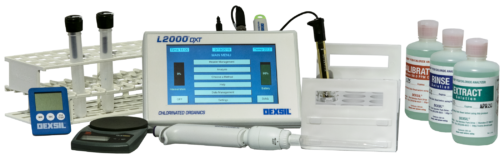
The L2000DXT PCB/Chloride Analyzer System is a versatile easy-to-use option for on-site analysis of PCB and other chlorinated organic compounds in four matrices; transformer oil, soil, water, and surface wipe samples. Decisions regarding site clean-up or remediation begin with determining and delineating the extent of contamination. The L2000DXT provides real- time results quickly, on-site, allowing for faster decision making while affording considerable time and cost savings when compared with laboratory analysis.
The basic principal of the L2000DXT system is to measure the total organic chlorine of a sample and equate that to an equivalent concentration of the target or expected analyte. Samples are extracted and reacted with a sodium reagent to strip the covalently bonded chlorine from the analyte(s) converting it to inorganic chloride. The resulting chloride is then detected and quantified using a chloride ion specific electrode. The L2000DXT then mathematically converts the chloride reading to the equivalent concentration of the target analyte based on the percent chlorine associated with the analyte. Conversion programs are available for all major Aroclors and most common chlorinated solvents and pesticides. Custom conversion programs can be built for less common analyte(s) not included on the L2000DXT menu, instructions are included in the user manual.
REAGENTS: Reagents are available in packs of 20 tests for soil, water, and surface wipes and by 40 tests for transformer oil testing. For larger projects, bulk packs of 200 are also available. Everything needed for the test procedure is included with the reagent packs. No other special equipment is needed. The reagents have a shelf life of 2 years. (Note: All L2000 reagent options may be used with both the L2000DX and L2000DXT analyzers.)
RESULTS: The usable result range for the L2000DXT is (MDL) 3 ppm - 2000 ppm. Results are displayed on the 7" LCD touch screen and are saved internally or onto the provided thumb drive. Pertinent information regarding the program in use, blank subtraction values, reporting units, and concentration values are clearly visible on the display. The data record can be customized to include project specific header information such as site location, sample ID, technician’s name, etc. The L2000DXT also stores the test data for later recall or upload via USB thumb drive.
POWER: When an external power source is not available, the L2000DXT can be operated with the rechargeable battery. A fully charged battery should provide power for a full 8 hour day of sample analyses. To preserve battery power, the unit will automatically shut off after 10 minutes of inactivity. The L2000DXT should be plugged into an AC outlet whenever possible to maintain the life of the battery.
TRAINING: The L2000DXT is designed for use in the field or laboratory by non-technical personnel. The user manual provides easy to follow, step-by-step instructions for quick familiarization with the system and analysis procedures. Review of the user manual is all that is necessary to successfully complete analyses with the L2000DXT; no formal training is required.
TIME: An oil sample requires about five minutes to run, while water, soil and surface tests take about ten minutes each. Several samples can be prepared concurrently, then analyzed in less than a minute per sample. Prepared samples can also be held for analysis at a later time. No refrigeration or special handling is required. Fast turn-around eliminates the need to wait days or even weeks for laboratory results. Crews working at a site can take immediate action to secure equipment, isolate a site, or remove contaminated soil.

There are no safety data sheets for this product
There are no technical papers for this product